Read my story at Inc Magazine.
This week, Slate Auto, the buzzy Bezos-backed startup, revealed the pricing on the cheapest new EV on sale in America.
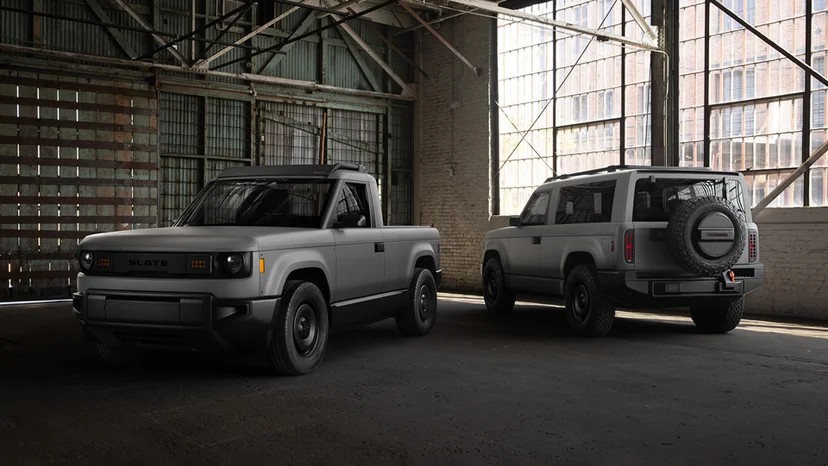
The bare-bones “Blank Slate” pickup starts at $24,950 before the destination charge, making it the least expensive new electric vehicle in the country. It is also the least expensive new pickup of any kind, and costs roughly half the price of the average new vehicle sold in the United States. Preorders opened a few hours before the event on Wednesday in Los Angeles, and Slate CEO Peter Faricy said that the company had already logged more than 10,000 preorders on top of the 180,000 refundable reservations it had gathered since revealing the truck in April last year.
That’s a commendable feat, considering that even Tesla, the most successful EV maker in the U.S., has, so far, never gone into production with its long-promised sub-$25,000 Model 2.
While Slate solved one of the industry’s biggest engineering challenges—building an affordable electric truck—the bigger question may be whether there are enough buyers left who actually want a stripped-down new vehicle.
Buyers at the bottom are stretched
The problem for Slate isn’t simply that it’s selling an inexpensive vehicle. It’s selling into the part of the market that’s shrinking the fastest. Automakers have increasingly relied on affluent buyers willing to spend $50,000 or more on new vehicles, while lower-income consumers have largely exited the new-car market altogether.
According to data from Cox Automotive, sales of the most affordable segments, specifically lower-priced vehicles like those Slate is selling, fell more steeply than the market overall in the first quarter of 2026. Cox attributed that to weaker demand from lower-income buyers and ongoing affordability pressure on mainstream shoppers. Resilient new-vehicle sales were bolstered by affluent households, Cox reported, lifted by record highs in the equity markets and the resulting wealth effect that flows from them.
And the EV picture is even more K-shaped. The average price of a new electric vehicle was $54,532 in May 2026, according to the most recent data; EV sales reached about 85,000 units that month, which Cox called the best month since the federal EV tax credits were revoked at the end of the third quarter of last year. That $7,500 credit, now gone, is the same subsidy that let Slate advertise a price under $20,000 at its launch last year.
“The new car market lost over a million buyers because things are unaffordable,” Faricy said in response to questions about the consumer market for Slate. “What we’re hoping is going to happen is now that we have the most affordable EV and truck in America, it’s going to actually make the new car market expand again, because people are going to be like, ‘oh my gosh, I can afford this.’
“If you’re talking about the difference between $25,000 and $30,000, that $5,000 is a big difference if you’re pushing your maximum ability to spend,” Stephanie Brinley, associate director of AutoIntelligence at S&P Global Mobility, says. “If you’re at that threshold, and you’re pushing your maximum disposable income to get to that, then that’s a huge difference.”
What do you really get for $25,000?
At that $24,950 price, the Blank Slate is very minimal. It’s a two-door, two-seat pickup with a single motor on the rear axle, about 181 horsepower, and an estimated 205 miles of electric range. There is no four-door version and no all-wheel drive. There is no central touchscreen, no built-in infotainment, and no stereo. The windows are hand-cranked. Air conditioning did make the cut, one of the few comforts the team kept after stripping the truck down to almost nothing, according to Chris Barman, president of vehicles at Slate Auto. Everything else, from armrests to speakers, body decals and wraps, are items you can opt to add on, for an additional price.
If you want the two-door Squareback SUV with seating for five, the starting price is $29,950, excluding destination and additional charges. Alternatively, you can turn your Blank Slate into the Squareback SUV with Slate accessories at a later date, when your budget permits. Slate is betting buyers will treat the truck more like a platform than a finished product, adding accessories over time as their finances allow.
Slate is also asking buyers to embrace an unconventional service model. Owners can install many accessories themselves, while more involved work can be done through RepairPal-affiliated shops. Slate will not have dealerships or service centers. Whether mainstream buyers embrace that approach remains an open question, particularly for a startup without an established retail network.
There’s also the issue of competition from well-established brands. Many of the big players recognize that the affordable market is unaddressed. Ford’s small electric truck, for example, is coming and will be priced starting around $30,000. It will go on sale sometime in 2027. With an established brand and dealerships and service centers across the country, this could pose a real threat to Slate’s model.
A perfect last-mile fleet vehicle?
A low-cost, low-frills 205-mile truck may not make sense to those at the lower end of the market, but it makes a lot of sense for fleets. A delivery van or a utility truck that runs a fixed local route and returns to base every night does not need long-range, all-wheel drive, or a stereo.
What fleets need is a low purchase price, low maintenance costs, and durability, something that both Faricy and Barman underlined as standout features of the Slate.
And the fleet market isn’t small. According to Cox, fleet sales for this year are expected to reach around 2.9 million units, down only slightly over the last year. Even in a softer market, commercial and government fleets are among the largest purchasing channels for automakers.
Both Slate executives pointed to features like their 10-year/110,000-mile battery warranty, self-service repairs, and Slate University, which offers lessons on troubleshooting errors and maintaining the vehicle without having to go to a RepairPal-certified shop for work, as reasons that fleet buyers would show interest in Slate vehicles.
Both confirmed that the company has strong interest from fleet companies and the military, but neither would name any specifics.
Slate’s bottom line
While the consumer launch has won the current headline cycle, fleet demand might ultimately prove more important to the business and the nearly finished Warsaw, Indiana plant, where Slate is planning to build as many as 150,000 vehicles per year.
Faricy said the company reaches break-even at roughly 80,000 vehicles a year, meaning sustained production volume will matter almost as much as the truck’s headline-grabbing price. Large fleet contracts, if they materialize, would provide the kind of repeat orders that startups often struggle to generate from retail buyers alone.
“I think the price is interesting,” Brinley said. “I think that the price of the accessories is super interesting. It’s an exciting car. But the question is, how long is that excitement sustained?”
Slate plans to begin production at the end of this year and deliveries soon thereafter.
