AI is coming for manufacturing jobs, and America isn’t ready.
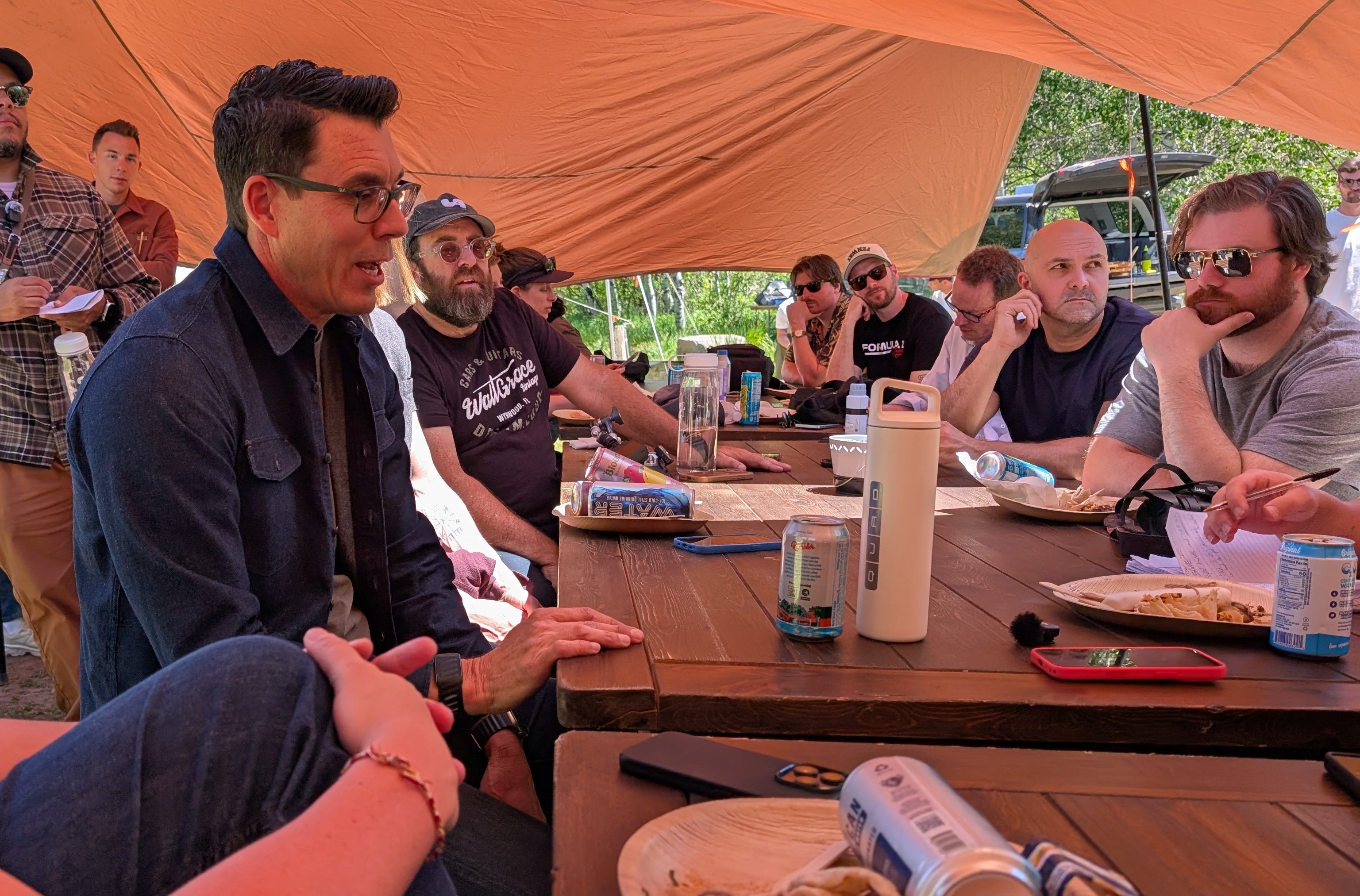
That was the message from Rivian CEO RJ Scaringe, made the week before the public launch of the company’s new R2 SUV. During a press roundtable on June 3, Scaringe said that AI is moving “an order of magnitude faster than the average person in society understands,” that policymakers are nowhere near serious enough about what that means for workers, and that the idea of continuing with the status quo approach to education in the U.S. is “wildly naive.”
“We as society have not yet honestly acknowledged how much needs to change, in particular with our education systems,” he said. “There’s not a single job today in our economy that doesn’t have an impact from AI.”
The remarks came from a CEO who also has skin in the game beyond just Rivian and is investing in the AI revolution in manufacturing. Late last year, Scaringe—who is on the cover of Inc. magazine’s summer issue—quietly founded a robotics startup called Mind Robotics that has already raised more than $1 billion since its stealth launch, bringing its valuation to $3.4 billion. Unlike the robots other companies are designing for potential use in people’s homes, Mind is focused on industrial robots and cobots (that is, robots that work alongside people).
Featured Video
Patty Arvielo on Hiring People Better Than You
In fact, Scaringe said that he plans to deploy Mind’s tactile robots inside Rivian’s own production plant within the year, making the company itself one of the early test cases for what AI-powered manufacturing looks like at scale.
Human-to-robot actions on the manufacturing line
Scaringe explained that if you walk into any major auto plant today, you will find two distinct worlds. The body shop, where metal is welded and shaped into a car’s structure, is almost entirely automated. There, the robots doing that work are six-axis arms performing what Scaringe called “truly geometrically repeatable tasks,” following a prescribed motion, over and over, and they are extraordinarily good at it.
General assembly, however, is different. There, human workers install seats, trim pieces, and upholstery sets. These items are similar each time but never in exactly the same position, requiring human interaction to place them just right because, for example, a bin of parts may shift or a car body may sit at a slightly different angle each time it rolls by on the line.
So far, robots haven’t developed the dexterity to fit fiddly parts like wiring harnesses together, at least at scale. The work requires constant micro-adjustment, which means these tasks need human hands. Yet, as Scaringe argued, humans were not physically built to do the same repetitive motion over and over, without wearing down their bodies, which is why robots and automation on the manufacturing line have made sense.
George Chowdhury, principal analyst at ABI Research, who covers industrial and collaborative robotics, says the challenge to creating cobots has always come down to physics. “It’s really about deformable objects,” he said. (Think: things like wiring harnesses, seating, and floor mats in a vehicle.) “They move depending on how you apply force to them, which means it’s very hard, nigh on impossible, to sequentially program a robot to handle it, because you can’t code for every contingency of how the object will change.”
The technology that has powered and programmed robots on the manufacturing floor has remained stuck in decades past, with programmable logic coded on the manufacturing floor. “There’s zero AI,” Scaringe said.
Before 2020, robots, like self-driving cars, were programmed to follow a specific set of rules. Engineers and programmers would write code that attempted to describe every possible scenario that an autonomous car might encounter, giving specific instructions about things like stop signs and crosswalks, Scaringe said. In a manufacturing environment, with its thousands of variables, rules-based programming is highly limited.
Then came the AI models, trained on complex, unpredictable systems. These models are a highly specialized type of neural network that are better at modeling context and relationships (which they don’t always get right for a variety of reasons). Notably, Rivian uses a hybrid of two types of AI systems in the R2 to control everything from the new automated driving system (called Universal Hands-Free) to the algorithm that helps drivers find reliable chargers along a route.
With the advent of AI, Scaringe said, the models used to program self-driving cars and hands-free systems can be applied to industrial robotics, opening the door to the creation of tactile robots that can handle delicate, deformable objects on a manufacturing line.
A robot company with a focus on human hands
That realization led Scaringe to create Mind Robotics; Mind’s website still offers very little information, but based on an interview Scaringe did with TechCrunch and what he shared at the R2 launch, it seems to be focused at least partially on replicating the fine motor skills and instant adjustability of human hands on the manufacturing line, a task that wouldn’t be possible without current AI models. (Before Mind was publicly known, it had the designation “Project Synapse.”)
While the company has been operating in stealth-like mode, Scaringe is betting big on the robots that Mind is currently building and programming.
He said during the discussion that Mind’s robots will be deployed inside Rivian’s own production plant in less than a year. Currently, the only operational production plants that Rivian has are those in Normal, Illinois. It is building a new plant in Georgia, but it likely won’t start producing vehicles until 2028.
“The moment we start to deploy, whether we want to unveil it or not, it’s out,” Scaringe said. “There are going to be thousands of people that are collaborating alongside these robots, that are gonna take a picture and say, ‘Hey, check this out, my co-worker’s name is Phil, and he’s a robot,’” he continued. “All these things that we used to think would be impossible for robots are very much not science fiction. This is very much going to be reality.”
Chowdhury says the timeline Scaringe is moving toward to allow tactile robots to work the manufacturing line is realistic. “There are companies doing this today. They are very small, because anything that involves vision, there are lots of things that can go wrong. But it’s very much already in use, at least very similar stacks,” he said, noting that he expects a lot of smaller cobots with hand-like ability to roll out more widely in the next two years.
Where does that leave human workers?
Scaringe pushed back on the conventional framing of automation as a harbinger of human job losses. He said that Rivian and other advanced manufacturing companies cannot find enough people to staff their existing plants, let alone the scaled-up operation that he hopes the new R2 will demand. The company is planning to have capacity for 160,000 Rivian R2s at the Normal, Illinois, plant initially, Scaringe said, with the option for additional capacity for R2s, R3s, and “other things that we haven’t shown yet” at the Georgia plant, which is currently being built. Georgia will have an initial capacity of 300,000 vehicles a year.
“There’s also a big perception like jobs are really lost,” he said. “We’ve got the messaging upside down on this, as a country, but there is an extreme lack of labor,” he continued. “We don’t have enough people, especially if we want to bring any level of manufacturing back into the United States.” Scaringe noted that Rivian struggles to hire enough people to work on the manufacturing floor and competes with the hospitality industry to recruit.
“We’ll take people in today that have never used a torque tool in their whole life,” Scaringe said at the roundtable, “and, in a period of three weeks, we have to teach them, this is a torque wrench, this is an electrical connection. We have a little university, our own training program, that we use to train people, but it’s a different style of work.”
Not everyone is convinced that Scaringe’s framing around jobs holds up, however. Tu Le, managing director of Sino Auto Insights, who advises automotive companies across the U.S. and Asia on mobility and manufacturing strategy, says the math points in a different direction. “Advanced manufacturing leads to fewer people in a factory. That combined with fewer parts in a vehicle or any consumer product, and there should be less people building it. That’s just simple math.”
Scaringe’s approach to robotics and their role, however, is markedly different and more considered than the one Elon Musk has taken. While Scaringe is focused on replicating human dexterity on the factory floor, Musk has taken a much more bombastic approach with his Optimus humanoid robots.
Speaking at the U.S.-Saudi Investment Forum in January, Musk argued that in 10 to 20 years, work will become “optional.” Musk has placed a big bet on his prediction, too, announcing plans late last year to end production of the Tesla Model X and Model S and repurpose those manufacturing lines to build Optimus humanoid robots, with the aim of producing one million per year. Musk plans to have those robots populate both his manufacturing plants and people’s homes.
The manufacturing and AI labor crisis is actually an education crisis
When asked who bears responsibility for training humans rather than replacing them with AI-controlled robots, Scaringe was animated and candid.
“[That] question is really important,” he said. “We as society have not yet honestly acknowledged how much needs to change, in particular with our education systems,” Scaringe said, arguing that AI is going to impact every job and fundamentally change the nature of work. “This is like the idea of going from a typewriter to a computer on steroids. To think that our education system can just sort of continue, status quo, is wildly naive.”
Scaringe said that he feels so strongly about this that he’s set aside a portion of his robot startup’s equity specifically to fund education-related STEM work.
In February, Rivian announced a partnership with CrunchLabs, founded by former NASA engineer and YouTube creator Mark Rober, whose channel has more than 77 million subscribers. The collaboration pairs Rober’s science storytelling with Rivian’s technology and manufacturing as its subject matter. Scaringe also mentioned that Rober recently announced he is putting $60 million toward building an entirely free science curriculum, since 40 percent of classrooms use his content from YouTube.
“I think we need more great minds thinking about how we can get kids excited about learning and engage their curiosity,” Scaringe said. “Because that’s what we need right now. We need tons of curiosity, because the world is way more complex than it used to be.”
Scaringe also said that the government needs to step up its role.
“Our policymakers need to actually get serious about this and recognize we can’t just ignore the fact that AI is coming. It’s going to come. It’s going to have enormous impacts on the fabric of society, and we need to prep our kids, and we need to prep the existing workforce,” he said.
