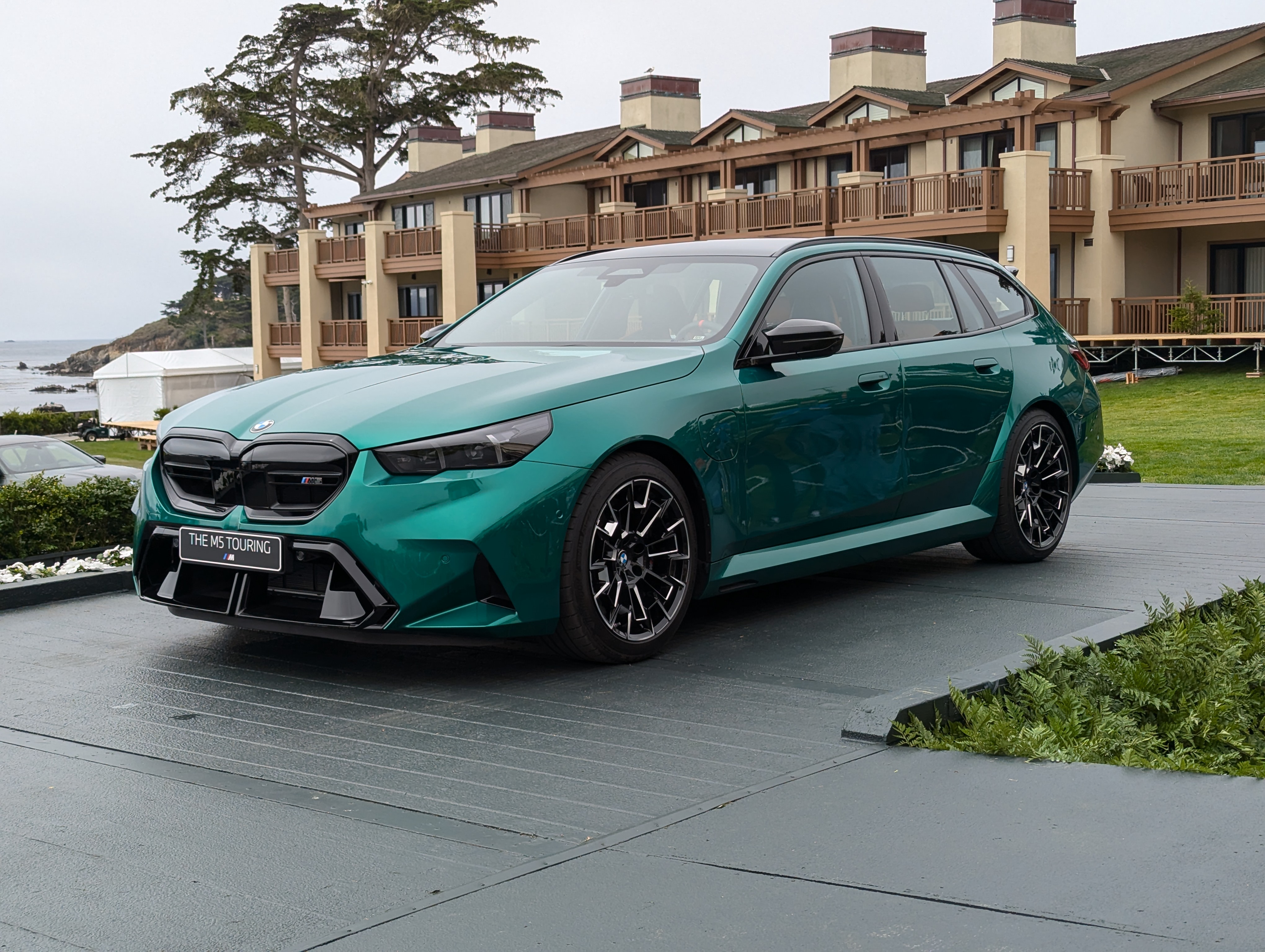
This week at the annual Car Week kerfuffle in Tony Pebble Beach, BMW is the star of the show. Events and races are planned around the Monterey Peninsula to herald a new set of M cars making their debut on US shores: the BMW M5 and M5 Touring. While both vehicles have been some of the worst-kept secrets in the business, they have enthusiasts pumped for what is coming next from the Bavarian automaker.
Earlier this year, at the Goodwood Festival of Speed, BMW launched its BMW M5 sedan with a new plug-in hybrid powertrain, and while BMW purists might bemoan the sunsetting of the sonorous V8s and V12s, the truth is that even the luxury automakers have to keep up with the global move to electrification. While BMW has a robust portfolio of very good EVs, known as BMW’s i-series (and its Neue Klasse concepts), it has yet to electrify the very pointy end of its lineup: the M vehicles.
The M5 sedan and M5 Touring–the latter of which happens to be the first M5 wagon to ever grace US shores–represent an incremental step toward the eventual electrification of that line, and a brief look at what the transition to a fully electric future might look like for BMW’s M line.
The new 2025 BMW M5 and M5 Touring both produce 717 horsepower and 738 pound-feet of torque, all of which come from a combination of a 14.8 kW lithium-ion battery powering a 194-hp motor integrated into the 8-speed transmission and a 4.4-liter twin-turbo V8 engine. The technology that underpins both is closely related to the race engine that powers the M8 hybrid race car, and BMW says that it took a lot of the lessons it learned through its racing arm, BMW Motorsport, to get the kind of performance numbers that M Series buyers expect from the brand. First impressions of the complex powertrain have been good, too.
According to Franciscus van Meel, BMW M CEO, the M-series is huge in the US, with more than 30% of the world’s volume sold stateside. California is the marque’s largest market. “It is also our most important BEV Market, and it accounts for 33 percent of all our BEV sales Nationwide, he told a small group who gathered at the famous 18th hole at Pebble Beach on Thursday.
In the U.S., there are only a handful of modern luxury wagons on the market: Volvo, Mercedes, Audi, and Porsche currently offer longroofs. That’s because SUVs have taken over as the family hauler of choice, and wagon sales (and thus options) have diminished as Americans pursue higher seating positions and more space.
Yet wagons have always held a very special place in automotive enthusiasts’ hearts for their car-like driving dynamics and useful space. There’s an exceedingly tired meme in automotive journalist circles about the mythical, brown, manual wagon that no one makes anymore, and the BMW M5 Touring should scratch that unicorn itch. That’s thanks in part to its 57.6 cubic feet of cargo space, combined with its promised M5 driving characteristics.
But with that hybrid powertrain, there’s a caveat: The weight. Some of the stats that have made their way around the Internet are eye-popping. According to reports, the new M5 with the PHEV powertrain weighs a whopping 1,100-plus pounds more than the outgoing M5, pushing the scales to a hefty 5,390 pounds. That’s as much as a Cadillac Escalade or a Ford Expedition. The Touring weighs an estimated 5,530 pounds, 200 pounds more than the sedan. The additional 800-plus pounds comes from the hybrid system but BMW insists that the weight won’t slow the new M5 down at all, claiming that the wagon can go from 0 to 60 in just 3.5 seconds not to mention manage 25 miles of all-electric range (but only if buyers actually charge them).
